
Adapting to Tariffs as Cautious Optimism Returns to Private Equity
August 2025


Adapting to Tariffs as Cautious Optimism Returns to Private Equity
August 2025
Private equity firms entered 2025 with hopes of a rebound in deal activity, fueled in part by expectations of a more M&A-friendly and business-oriented U.S. administration. Instead, the reality has been eight months of unease and uncertainty driven by concerns over global trade policy and tariffs, a volatile geopolitical environment, the threat of inflation, higher-for-longer interest rates and potential recession – all of which have weighed on sentiment as well as activity levels. As we pass into the last quarter of year, there are signs that the risk of some of the most extreme scenarios may have lessened and cautious optimism appears to be returning, potentially enabling both targeted exits and investments. Nevertheless, private equity firms remain wary of navigating the challenges posed by an uncertain and rapidly evolving environment. The outlook for the remainder of the year is still complex and fluid.


Deals Cautiously Continue Against Uncertain Backdrop
The breadth and scale of Donald Trump’s “Liberation Day” tariffs took markets by surprise, with the S&P 500 losing over 10% in two bruising sessions following the announcements on April 2 and many international indices following suit. Since then, markets have recovered as many tariff threats were suspended and trade deals negotiated. By early May, the U.S. benchmark was back to its pre-announcement level and has since broadly continued to advance, despite the renewal of tariff threats from mid-July into August.
Private equity sentiment, while less visible and less volatile than public markets, has echoed this trend, with many potential buyers and sellers initially adopting a cautious “wait-and-see” approach. First quarter data shows a mixed bag, reflective of market caution alongside the determination to conclude deals for larger-sized, attractive assets already in the pipeline. PitchBook estimates that global deal value reached $495Bn in the first quarter, up 7% on the prior quarter, although the number of deals fell 12%1. Exits saw a similar trend, with total exit value (including estimated deals) at their highest level since the end of 2021 but with some skewing of the data toward the bigger deals.
Global PE Activity from
2021 to 2025 Q1
Hover to find out more
Source: PitchBook
Deals Cautiously Continue Against Uncertain Backdrop
The breadth and scale of Donald Trump’s “Liberation Day” tariffs took markets by surprise, with the S&P 500 losing over 10% in two bruising sessions following the announcements on April 2, and many international indices following suit. Since then, markets have recovered as many tariff threats were suspended and trade deals negotiated. By early May, the U.S. benchmark was back to its pre-announcement level and has since broadly continued to advance, despite the renewal of tariff threats from mid-July into August.
Private equity sentiment, while less visible and less volatile than public markets, has echoed this trend, with many potential buyers and sellers initially adopting a cautious “wait-and-see” approach. First quarter data shows a mixed bag, reflective of market caution alongside the determination to conclude deals for larger-sized, attractive assets already in the pipeline. PitchBook estimates that global deal value reached $495Bn in the first quarter, up 7% on the prior quarter, although the number of deals fell 12%1. Exits saw a similar trend, with total exit value (including estimated deals) at their highest level since the end of 2021 but with some skewing of the data toward the bigger deals.
Global PE Activity from
2021 to 2025 Q1
Click to find out more
Source: PitchBook


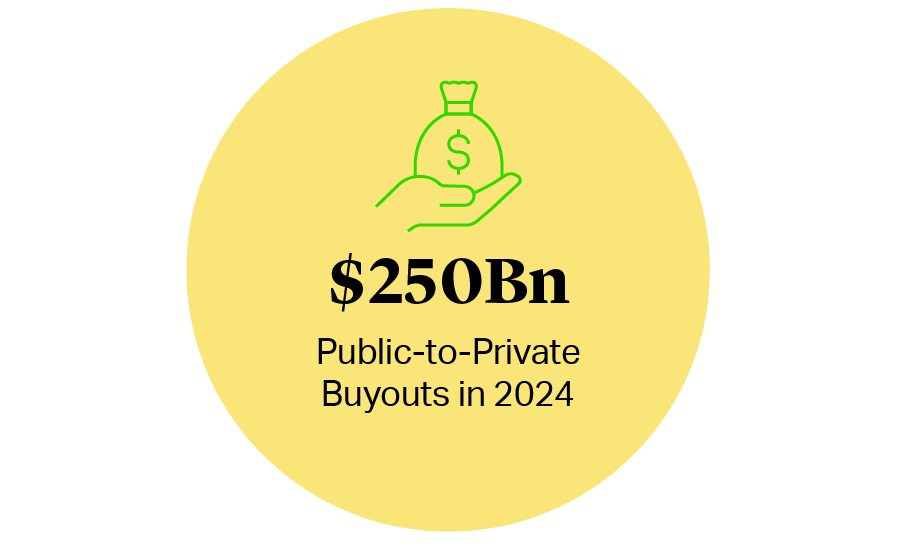
Among the high points was Sycamore Partners’ take-private transaction of U.S.-listed Walgreens at an enterprise valuation of almost $24Bn2 and, in the UK, some notable public-to-private activity in relation to Spectris plc and Assura Plc. These buyouts were part of a broader trend of public-to-private activity as sponsors find opportunities in unloved or mispriced assets in U.S. and European public markets. According to Bain & Co, such deals increased to nearly $250Bn globally in 2024 and accounted for almost 50% of deals worth $5Bn and above in North America3.
Public-to-Private Buyouts in 2024

Source: Bain & Co


Notable Private Equity
Transactions in 2025 Q2
Hover to find out more
Source: Financial Times
While overall trends have continued to reflect significant global economic uncertainty with some further softening early on, activity has continued in the second quarter with sizeable investments across sectors and businesses deemed resilient to market disruption. In April, EQT sold a €3Bn stake in software company IFS to Abu Dhabi Investment Authority and the Canada Pension Plan Investment Board at a valuation of €15Bn4. This was followed in May by Italian energy group Eni announcing exclusive negotiations with Ares Management to sell 20% of its renewable energy and EV charging division at a valuation exceeding €12Bn5 and the acquisition of Citigroup’s Polish consumer banking unit by Cerberus-backed lender VeloBank6.
With an estimated $1.6Tn in dry powder to deploy and a persistent need to exit investments and return capital to investors, EY’s Q1 Private Equity Pulse positioned sponsor sentiment moderately in the “risk on” range by May, signaling appetite for more deals – absent any further market shocks7.
Notable Private Equity
Transactions in 2025 Q2
Click to find out more
Source: Financial Times
While overall trends have continued to reflect significant global economic uncertainty with some further softening early on, activity has continued in the second quarter with sizeable investments across sectors and businesses deemed resilient to market disruption. In April, EQT sold a €3Bn stake in software company IFS to Abu Dhabi Investment Authority and the Canada Pension Plan Investment Board at a valuation of €15Bn4. This was followed in May by Italian energy group Eni announcing exclusive negotiations with Ares Management to sell 20% of its renewable energy and EV charging division at a valuation exceeding €12Bn5 and the acquisition of Citigroup’s Polish consumer banking unit by Cerberus-backed lender VeloBank6.
With an estimated $1.6Tn in dry powder to deploy and a persistent need to exit investments and return capital to investors, EY’s Q1 Private Equity Pulse positioned sponsor sentiment moderately in the “risk on” range by May, signaling appetite for more deals – absent any further market shocks7.
Taking Care in a Volatile Tariff Environment
Despite a rising appetite to invest and some recent encouragement for investors that markets are stabilizing, private equity firms remain acutely aware that the environment can change quickly and unpredictably. As a result, safeguards are being implemented where possible, for example by interrogating specific diligence items before acquisition and translating the impact (or potential impact) of tariffs to transaction fundamentals and deal pricing. Notably:


- Even with trade agreements being put in place, it appears that tariffs will be higher in most geographies than before the arrival of the Trump administration. This has the potential to create pressure on margins, impacting EBITDA levels, and ultimately valuations for private equity-owned companies.
- Where a target business manufactures goods, or relies on goods that are sourced internationally, private equity firms must scrutinize supply chains during the due diligence process. It is important for investors to understand where all the elements of goods are made and how supply chains can be altered or strengthened, for example by increased localization.
- Firms must also understand the U.S. rules of origin around tariffs on manufactured goods. It is equally important to consider China’s position and response regarding imports, including manufactured goods. While certain goods are included in a long list of tariff exemptions8, the Chinese authorities have powers to investigate and take action against businesses attempting to circumvent the trade rules9.


Taking Care in a Volatile Tariff Environment
Despite a rising appetite to invest and some recent encouragement for investors that markets are stabilizing, private equity firms remain acutely aware that the environment can change quickly and unpredictably. As a result, safeguards are being implemented where possible, for example by interrogating specific diligence items before acquisition and translating the impact (or potential impact) of tariffs to transaction fundamentals and deal pricing. Notably:
- Even with trade agreements being put in place, it appears that tariffs will be higher in most geographies than before the arrival of the Trump administration. This has the potential to create pressure on margins, impacting EBITDA levels, and ultimately valuations for private equity-owned companies.
- Where a target business manufactures goods, or relies on goods that are sourced internationally, private equity firms must scrutinize supply chains during the due diligence process. It is important for investors to understand where all the elements of goods are made and how supply chains can be altered or strengthened, for example by increased localization.
- Firms must also understand the U.S. rules of origin around tariffs on manufactured goods. It is equally important to consider China’s position and response regarding imports, including manufactured goods. While certain goods are included in a long list of tariff exemptions8, the Chinese authorities have powers to investigate and take action against businesses attempting to circumvent the trade rules9.
U.S. Unpredictability Causes Sponsors to Reassess Europe
A notable geographical consequence of the increased trade unpredictability and a shift in the geopolitical dynamics is that Europe is benefitting from a positive security reassessment and is increasingly attractive as an investment destination for private equity and venture capital. Large institutional investors are increasing their weighting to European assets10. Private equity executives attending SuperReturn in Berlin in June were also increasingly bullish on opportunities, with leaders from firms including Ares, Carlyle Group and Sixth Street highlighting a “yawning valuation gap” relative to U.S. assets since 2008, as well as political action to increase critical investment11.
Size of EU Investments into Defense Spending and AI
Hover to find out more
SOURCE: France24/Science Business
U.S. Unpredictability Causes Sponsors to Reassess Europe
A notable geographical consequence of the increased trade unpredictability and a shift in the geopolitical dynamics is that Europe is benefitting from a positive security reassessment and is increasingly attractive as an investment destination for private equity and venture capital. Large institutional investors are increasing their weighting to European assets10. Private equity executives attending SuperReturn in Berlin in June were also increasingly bullish on opportunities, with leaders from firms including Ares, Carlyle Group, and Sixth Street highlighting a “yawning valuation gap” relative to U.S. assets since 2008, as well as political action to increase critical investment11.
Size of EU Investments into Defense Spending and AI
Click to find out more
SOURCE: France24/Science Business
Since the advent of the Trump administration, European national governments and the EU have unveiled measures to significantly increase spending across fields such as AI, defense and infrastructure. Among the most eye-catching is the new German government’s decision to loosen its fiscal rules to create a fund of up to €500Bn for infrastructure, which it has supplemented with explicit calls for private capital investment12.
At the same time, the EU is targeting a sizeable increase in defense spending, with member states having agreed to the creation of a €150Bn loan program, which Brussels hopes could unlock up to €800Bn of investment for defense start-ups and companies in Europe13. Furthermore, in an attempt to keep pace with the U.S. and China, the European Commission has also confirmed plans to mobilize up to €200Bn for AI, which will include €20Bn for AI gigafactories and training large AI models14.


Private capital investors are already moving money behind these trends. In June, Brookfield announced an investment of approximately $10Bn in a new data center in Strängnäs, in what could be Sweden’s largest ever foreign direct investment. The firm’s European head hailed the country as a “strategic hub for artificial intelligence”, indicating the potential for further investment15.
AI, defense, and infrastructure are not the only sectors to receive increased attention. Both private equity and corporates are demonstrating a strong appetite for assets that tap into Europe’s track record in biotech and healthcare innovation. Earlier this year, Swiss pharmaceutical group Novartis struck a $3.1Bn deal with Blackstone Life Sciences and Novo Holdings to acquire Anthos, a company formed to develop, manufacture, and commercialize abelacimab16, a stroke treatment that originated at Novartis and has now spun out to finalize clinical trials.






Since the advent of the Trump administration, European national governments and the EU have unveiled measures to significantly increase spending across fields such as AI, defense and infrastructure. Among the most eye-catching is the new German government’s decision to loosen its fiscal rules to create a fund of up to €500Bn for infrastructure, which it has supplemented with explicit calls for private capital investment12.
At the same time, the EU is targeting a sizeable increase in defense spending, with member states having agreed to the creation of a €150Bn loan program, which Brussels hopes could unlock up to €800Bn of investment for defense start-ups and companies in Europe13. Furthermore, in an attempt to keep pace with the U.S. and China, the European Commission has also confirmed plans to mobilize up to €200Bn for AI, which will include €20Bn for AI gigafactories and training large AI models14.
Private capital investors are already moving money behind these trends. In June, Brookfield announced an investment of approximately $10Bn in a new data center in Strängnäs, in what could be Sweden’s largest ever foreign direct investment. The firm’s European head hailed the country as a “strategic hub for artificial intelligence”, indicating the potential for further investment15.
AI, defense, and infrastructure are not the only sectors to receive increased attention. Both private equity and corporates are demonstrating a strong appetite for assets that tap into Europe’s track record in biotech and healthcare innovation. Earlier this year, Swiss pharmaceutical group Novartis struck a $3.1Bn deal with Blackstone Life Sciences and Novo Holdings to acquire Anthos, a company formed to develop, manufacture, and commercialize abelacimab16, a stroke treatment that originated at Novartis and has now spun out to finalize clinical trials.
Conclusion
As the dust settles after an eventful few months, with the cycle of the U.S. administration’s opening tariff announcement, counter measures from China, preliminary trade agreements, and some softening of opening stances having now played out, the markets seem to be recovering, and investor sentiment seems to be improving. Private equity’s desire for deals is also cautiously bouncing back, with firms finding dislocation in public markets and potentially attractive valuation entry points into assets. There are also growing thematic tailwinds in Europe with programs to invest in defense, digitalization and infrastructure.
However, the status quo can change quickly, and there are unquantifiable risks. Consumer sentiment remains weak. Recession or stagflation may still occur once tariff measures start to bite, pushing up prices and reducing economic growth, and the implications of the recent budget changes in the U.S., and those anticipated in the UK, will need to be factored in. Private equity firms will need to continue living with – and adapting to – these risks in order to get deals done and ensure that their portfolio companies thrive.
This article was prepared with contributions from Cleary associates Hans Van Daele and Alexandra Dawson.



 Built with Shorthand