


The United Arab Emirates (UAE) is a civil law jurisdiction containing a complex and layered insolvency regime. The principal corporate insolvency law is Federal Law No. 9 of 2016 (the UAE Bankruptcy Law). Law is created at both the federal and emirate level and the UAE also has 45 ‘free-zones’ with their own laws or regulations.
Outside free zones (or ‘onshore’), federal and emirate-level laws apply. There are two special sub-sets of ‘financial’ free zones, the Dubai International Financial Centre (DIFC) and the Abu Dhabi Global Market (ADGM), where onshore civil and commercial laws do not apply. ADGM and DIFC are common law jurisdictions, with rules based closely on the UK FCA regulatory regime and with their own insolvency regimes applicable to the companies incorporated within their jurisdiction.
This overview of the insolvency regimes in ADGM, DIFC and onshore explains how new money can be raised under each regime.






The main restructuring and insolvency options under ADGM law are administration, receivership/administrative receivership, deeds of company arrangement (along with administration), schemes of arrangement and liquidation. They are all regulated by the Abu Dhabi Global Market Insolvency Regulations 2015 (the ADGM Insolvency Regulations), apart from the scheme of arrangement, governed by the Companies Regulations 2015 (the ADGM Companies Regulations). The ADGM Insolvency Regulations are modelled on the UK’s Insolvency Act 1986.
An administrator can be appointed to take over the management of a distressed company pursuant to the applicable regulations either:
- by the debtor company itself (or by its directors) if the debtor is unable or is unlikely to pay its debts;
- by a creditor holding security over the whole or substantially the whole of the debtor company’s assets, where the security document contemplates such appointment and where the relevant security has become enforceable; or
- by the court upon the application of the debtor company, its directors or one or more creditors, if the court is satisfied that the debtor is unable or unlikely to pay its debts.
The administrator owes a duty of care to the creditors as a whole. The administration must be carried out for one of the following purposes:
- rescue the company as a going concern;
- achieve a better result for the company’s creditors than would be likely if the company were wound up without going into administration; or
- realize property so as to make a distribution to one or more secured or preferential creditors.
The administrator must aim to pursue the first objective and the other objectives may only be pursued in descending order if the previous objectives are not reasonably practicable, among other considerations to be taken into account by the administrator.
For as long as an administrator is appointed, no resolution may be passed to wind up the company, no steps may be taken to enforce security over the company’s property and no other legal proceedings may be brought against the company except with the consent of the administrator or the court.
The ADGM Insolvency Regulations makes a distinction between receivers and administrative receivers. A receiver collects and sells any part of the secured property on behalf of a creditor. An administrative receiver is authorized to take over the management of the business of the debtor company.
Both receivers and administrative receivers are required to act in the interests of the persons by whom or on whose behalf they were appointed.
A company in administration may enter into a Deed of Company Arrangement if it is approved by creditors representing a majority (in value) of those voting on the matter. This is a binding arrangement under which creditor claims are compromised. There is no prescribed form for such an arrangement.
If the Deed of Company Arrangement is approved, it will bind all unsecured creditors (even those who voted against it). Secured creditors will only be bound if they voted in favor or the ADGM court has, on the application of the administrator, made an order to this effect.
Certain preferential creditors (employee and pension payments) will be entitled to a priority at least equal to what they would have been entitled to receive on a winding up.
The mechanism is closely modelled on English law. Accordingly, creditors are divided into aligned classes to vote. It must be approved by 75% (in value) of each class of creditor.
There is no requirement for a Scheme of Arrangement to be approved by a majority (by number) of each class of creditor. Therefore, it is less likely that low value creditors will block adoption.
The Scheme of Arrangement will bind the debtor company and all of its creditors that were entitled to vote, including any dissenting creditors (whether or not secured).
A liquidation may be proposed by the debtor itself, its directors or any creditor, and may be approved by the ADGM court based on satisfaction of one or more of the following criteria:
- the debtor has, by special resolution of the shareholders, resolved that the debtor be wound up;
- the debtor is unable to pay its debts (either on a cashflow or balance sheet basis or following a failure to pay a debt within three weeks of formal demand);
- the ADGM court is permitted to make such an order pursuant to any other provision of ADGM law; or
- the ADGM court is of the opinion that it is just and equitable that the debtor be wound up.
Any liquidation must be formally approved by the ADGM courts and will be binding on the debtor and all of its creditors.
An administrator may obtain unsecured credit and incur unsecured debt in the ordinary course of business if the entity is under administration (but not under a scheme of arrangement). A ‘roll-up’ of debt (whereby pre-petition lenders offer and obtain a post-petition facility that effectively pays off (or rolls-up) the pre-petition secured debt) is also possible. This process can take place in a single stage or, as additional money is borrowed, the debtor applies an equivalent amount of collateral sale proceeds first to the repayment of the pre-petition facility until the outstanding obligations are fully “rolled” into the post-petition facility. The roll-up can effectively transform the existing lenders’ pre-petition claims into a post-petition, administrative expense and obtain priority status.





Restructuring and insolvency options under DIFC law include company voluntary arrangements, company receivership, a debtor in possession regime (rehabilitation), administration and both voluntary and involuntary winding-up procedures. The DIFC Insolvency Law sets out the procedures that result in the reorganization or liquidation of an insolvent company.
Directors may make a proposal to members and creditors for a scheme of arrangement (a Voluntary Arrangement). Directors will appoint a DIFC registered insolvency practitioner as ‘nominee’. Directors must provide the nominee with a proposal containing information on matters including assets; any security provided by the company; liabilities; creditors; and whether they are aware of transactions that would be classified as preferences, transactions at an undervalue or invalid security interests (if the company were to go into liquidation).


The rights of preferred or secured creditors cannot be affected without their prior approval.
A creditor may only appoint a receiver if it has been granted specific power to do so in an instrument executed by the company (i.e., a credit agreement). An administrative receiver may dispose of charged property in certain circumstances.
The most significant points to note are that an administrative receiver has the power to:
Rehabilitation allows a debtor to remain in control and continue to manage its business and assets.
If directors consider it likely that a company may be unable to pay its debts, they can submit a Rehabilitation Plan to the court. The court will convene, and an automatic moratorium will apply to all creditors in respect of the company and its assets.
A Rehabilitation Plan application shall, amongst other matters, have the following effects:
If at least three quarters in value of any class of creditors or shareholders agree to the Rehabilitation Plan and it obtains court approval, it becomes binding on all persons within such class. The law also has a ‘cram down’ mechanism that can apply across the classes of creditors in certain circumstances.

The Rehabilitation Plan may be challenged under certain circumstances by any member of a class of creditors.
The DIFC Insolvency Law allows for the appointment of an independent administrator where an application for rehabilitation has been made and there is evidence of misconduct. One or more creditors may make an application.
When the court order is in force, the affairs, business and property of the company shall be managed by the insolvency practitioner. On appointment, any petition for winding up shall be dismissed and any administrative receiver shall vacate their position.
The winding-up of a company may be either voluntary (instigated by the company) or compulsory (instigated by the DIFC court). A company may be wound up voluntarily:
- in accordance with its memorandum and articles of association;
- if the company’s shareholders resolve that it should be wound up voluntarily; or
- if the company’s shareholders resolve that it cannot by reason of its liabilities continue its business.
A company may be wound up by the DIFC court if:
- the company has resolved so;
- the company is unable to pay its debts;
- a DIFC court ordered moratorium has expired and no Voluntary Arrangement has been approved;
- the DIFC court makes such an order pursuant to any provision of DIFC Law; or
- the DIFC court is of the opinion that it is just and equitable that the company should be wound up.
In case of Rehabilitation, the DIFC court may, in its discretion, authorize a DIFC company to obtain secured or unsecured credit and incur secured or unsecured debt. Such debt (including any interest) has priority over unsecured debt or is secured by an interest on the property of a DIFC company that is not otherwise subject to a security interest, or is secured by a junior security interest on the property of a DIFC company that is already subject to a security interest.




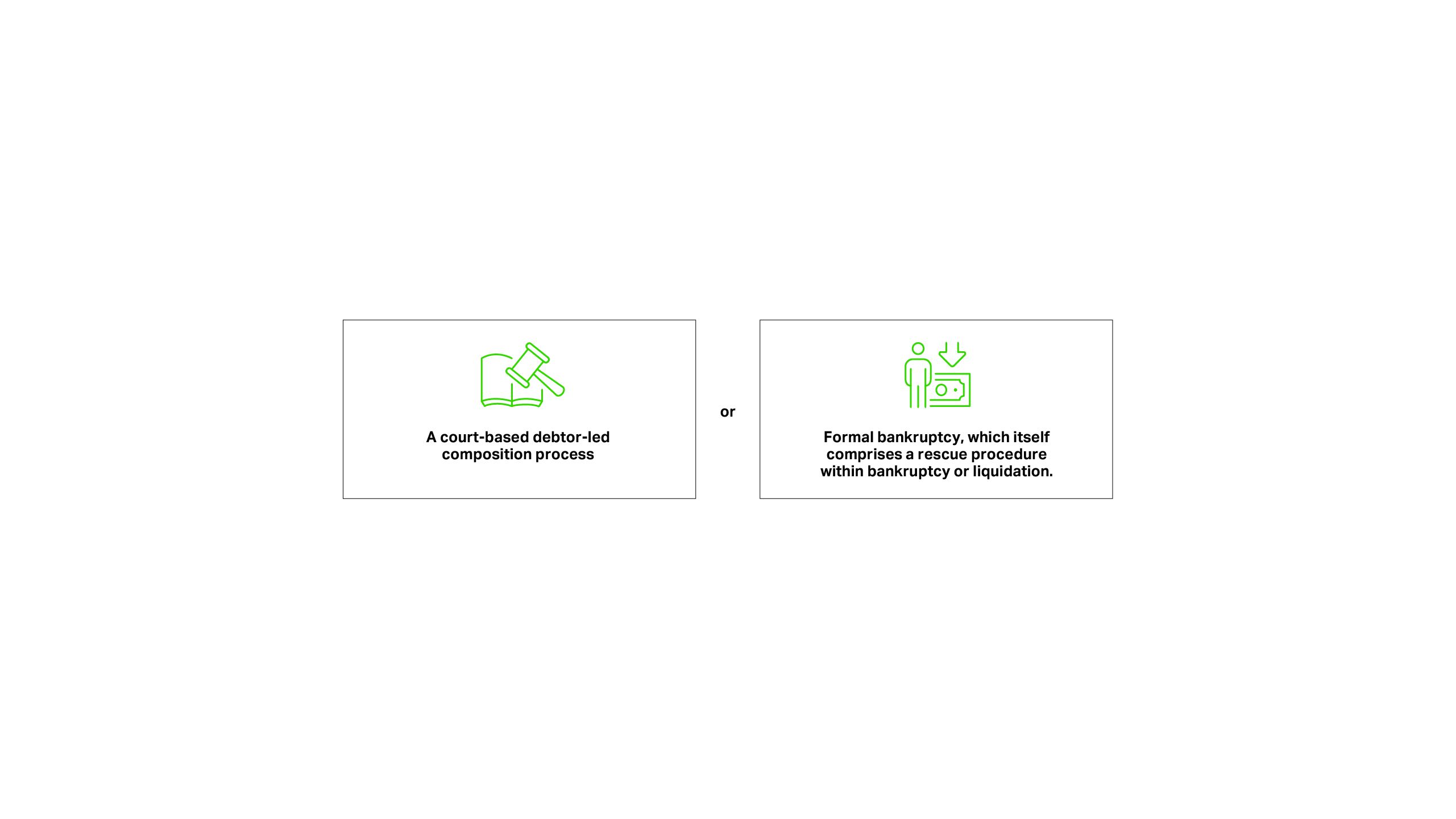
The UAE Bankruptcy Law applies to incorporated companies, corporate entities and sole traders/individuals trading for profit. Its composition and restructuring process can apply to companies in the non-financial free zones.
There are two principal insolvency options under UAE law which are both determined by the court:

The protective composition procedure (PCP) is used when a debtor experiences financial difficulties but is not yet insolvent or has been in a state of over indebtedness or cessation of payments for less than 30 consecutive business days.
An application can only be made by the debtor or ordered by the court, not by creditors. Shareholders must also approve the application. If the court accepts the application, a moratorium on creditor action will immediately apply. The moratorium will not prevent the enforcement of secured claims, which may still occur with permission of the court. The debtor continues to manage its business and is given time to devise a restructuring plan under the supervision of the officeholder. The restructuring plan must be approved by a majority representing at least two-thirds in value of each class.
A bankruptcy filing can be made by the company, a creditor or the court. A shareholders’ resolution approving the filing must also be submitted to the court with the application.

Further, the court or regulator may initiate bankruptcy proceedings in certain prescribed circumstances.
The court has discretion to determine whether a company can be rescued and will consider two main questions when making such determination:
- will assets cover the costs of a restructuring, and
- can the business be rescued?
If the court accepts the application, a moratorium on creditor action (excluding enforcement of secured claims that may occur with permission of the court) will immediately apply and the court will place the debtor under the control of one or more officeholders. The officeholder must prepare a report on the debtor’s business for the court, in consultation with the debtor.
Once the court is satisfied with the report, it is provided to creditors for comment, ahead of a hearing in which the court will either order the production of a restructuring plan for creditors to vote on, or the liquidation of the debtor.
If the court determines that it is not possible to rescue the debtor in accordance with a PCP or within a bankruptcy process, the debtor will be liquidated.
New financing, whether secured or unsecured, can be obtained during a PCP or rescue in bankruptcy with court permission. New financing shall have priority over any ordinary outstanding debt owed by the debtor on the date of initiating procedures.
It is possible to guarantee the new financing by pledging any of the non-pledged properties of the debtor or by arranging a pledge on the properties of the debtor that have already been pledged and that have a value exceeding the value of the debt guaranteed by the previous pledge (in which case the new pledge shall have a lower rank than the existing pledge on the same properties, unless the existing creditors agree that the new pledge will rank equal to or more senior than the existing pledge on the same property).
The UAE’s layered insolvency regime sees corporate structures sometimes stretching across the mainland and free zones, with enforcement action occurring in the onshore, ADGM and DIFC courts simultaneously. Questions of recognition and other inter-jurisdictional issues need to be resolved. Therefore, those tasked with saving a viable business through a UAE restructuring will need patience and good guidance.





Authors
Mark Brown
Partner, Al Tamimi UAE
Abu Dhabi, United Arab Emirates
T: +971 (0) 2 813 0464
m.brown@tamimi.com
Juliana Apopo
Associate, Al Tamimi UAE
Abu Dhabi, United Arab Emirates
T: +971 4 364 1641
F: +971 4 364 1777


 Built with Shorthand